


Re-investigating Perth’s school walkability: A 15-year perspective
An overview of the completed project “TRavel, Environment and Kids (TREK) Study: 15 years on”, plus a downloadable copy of the project’s final report.


Rather than simply aspiring to replace all of Australia’s gas-guzzling cars with electric vehicles, micromobility initiatives encourage people to rethink their relationship with transport and reduce their reliance on cars in favour of smaller vehicles.
Micromobility refers to small, lightweight vehicles which are intended for travel on public roads. Definitions vary, but they offer typical top speeds of less than 25 km/h, weigh less than 500 kg and exclude devices with internal combustion engines.
Micromobility vehicles can be either privately owned or made available for the public as shared vehicles. Over the past few years worldwide there has been an increasing number of e-bicycles and e-scooters that can be hired by anyone as their need arises.

A taxonomy of active modes and related categories. Source: More than walking and cycling: What is ‘active travel’?
Micromobility vehicles are designed to be operated by a single person and travel over short distances in urban environments. Some like bicycles are fully human-powered, while others like electric pedal-assisted (pedelec) bicycles and electric skateboards are partially human-powered. Fully motorised micromobility vehicles include electric bikes and electric scooters.
As mentioned earlier. along with private ownership, micromobility initiatives can include sharing. This can see micromobility play a role in Mobility as a Service (MaaS) programs, including multimodal transport.
While a shift to electric vehicles can help Australia reduce carbon emissions, this doesn’t address all of Australia’s transport challenges. It is also important to rethink the number of cars on the road and traditional models of vehicle ownership.
Increased reliance on micromobility can reduce the number of cars on the road and curb traffic congestion. This offers a range of flow-on effects for all road users, from decreased travel times to reduced fuel bills and carbon emissions.
As Australia tackles urban sprawl by increasing population density in city centres and inner suburbs, micromobility can both reduce congestion and alleviate the demand for on- and off-street parking capacity.
Cheaper to own and operate than a car, plus easier to park, micromobility vehicles have particular appeal for urban delivery drivers who already tend to favour motor scooters over cars.
When it comes to sustainability, micromobility vehicles require less energy than cars to operate and produce. This includes reliance on a smaller battery, or no battery at all. Meanwhile, the average car tyre sheds 4 kg of microplastics in its lifecycle, regardless of whether it’s attached to an electric or internal combustion engine-powered vehicle. Micromobility vehicles rely on smaller, lighter tyres with less of an environmental impact.
The caveat of course on their environmental impact is whether or not micromobility vehicles improve the level of greenhouse gas emissions at the point of use, which depends on the mode that the e-scooter replaces. It is likely greater emissions savings may come from private e-scooter use as these appear to substitute for a greater number of trips than from shared e-scooter use.
The exercise aspect of riding partially human-powered micromobility vehicle has health benefits for users, while car drivers also benefit from reduced road congestion through shorter commute times, which reduce inactivity and improve work-life balance. The combined physical and mental health benefits for both micromobility riders and car drivers helps alleviate the social and economic costs of significant public health issues such as depression and obesity.
Of course in the case of e-scooters, the benefits to users are strongly related to the mode which the e-scooter trip replaces. From a public health perspective, e-scooter users who do substitute from a more active transport mode (cycling or walking) will suffer from a decreased health benefit from lower activity and any benefits will be very much outweighed by the impact of health exposure and incidence of traffic accidents. However, there is evidence (e.g. from UK trials) that e-scooters are being used to make trips that would otherwise not be made giving positive social inclusion impacts, although negative impact on emissions.
While micromobility can reduce the size and environmental impact of vehicles on the road, one trade-off is that – by only carrying a single person – they could potentially increase the number of vehicles on the road. Addressing this may require traffic planners to take a new approach to traffic congestion management which allows for micromobility vehicles in the mix.
Micromobility adoption also faces regulatory challenges when it comes to riding some vehicles on public roads. While limited trials of rented e-scooters have been undertaken by private companies in most major cities, it remains illegal to ride privately-owned e-scooters outside private property in New South Wales, South Australia, and the Northern Territory.
The laws vary in other states, with e-scooters legal in Queensland and under trial in Victoria. They must not exceed top speeds of 25 km/h to be road legal and can only be ridden on roads with up to a 60 km/h speed limit in Victoria (50 km/h in Queensland). It is illegal to ride e-scooters on Victorian footpaths, while there is a 12 km/h footpath speed limit in Queensland.
Under national laws, e-bike motors must be limited to 250 watts, must assist only up to 25 kilometres an hour, and must be activated by pedalling rather than with a throttle in order to be used in public (all of this is of course subject to changes of the laws – what appears here is the case in July 2023).
The need to wear helmets whilst riding bicycles, e-bikes and e-scooters has also created challenges when it comes to sharing services. Some people don’t like helmets, or simply refuse to wear them. Ensuring that helmets are always available with each shared vehicle can also be a challenge.
These services also face regulatory challenges when it comes to local councils managing their impact on footpath space. Clogging up footpaths also presents public acceptance challenges.
Additionally, micromobility presents safety challenges, considering that riders are classified as vulnerable road users (VRUs) who have little or no protection in the event of an accident. Vulnerable road users accounted for a third of Australia’s road toll in 2020. When it comes to serious injuries, that rises to almost half of all incidents.
The dangers extend to ensuring that micromobility riders respect road laws and other road users, including pedestrians. Closer to home, micromobility vehicles can also present a fire risk when it comes to battery charging. How big an issue all of this is somewhat unknown, and does on occasion receive disproportionate media coverage.
That said, people are being injured, or placed in danger of being so by uncaring or illegal use, and it is something that both local councils and share vehicle providers acknowledge could be improved, either by better public education on safe use, or even perhaps by technology to help lessen unsafe use.
While Australia has traditionally been a car-centric culture, people may become less enamoured with owning cars as they embrace higher-density inner-suburban living to avoid long commutes and be closer to amenities. Younger Australians are also more open to new technology, the shared economy, and efforts to reduce their environmental footprint.
At the same time, micromobility will likely remain less practical in outer suburban and rural areas where people must travel further distances on roads less suited to micromobility vehicles.
The appeal of micromobility will also increase as light electric vehicle technology improves, such as the energy density of batteries increasing their range. Increased sales and economies of scale will also make micromobility vehicles more affordable.
Increasing regulatory, financial support, and safety management will also help drive micromobility adoption. For example, Australia’s government-owned Clean Energy Finance Corporation was the lead investor in a $16 million fundraising round for delivery e-bike start-up Zoomo.
Some analysts believe the world may have already passed “peak car” – the point at which car ownership and usage levels plateau and begin to decline. In the US, this can already be seen in a drop in the number of automobiles that factories produce each year, the number of miles the average person drives and the proportion of young Americans with a drivers’ licence.
Lastly, it could be that the future of micromobility lies in supplementing and complementing existing public (and private) transport services.
This short video is about the Light Insight Trial, a project iMOVE ran with the Transport Accident Commission (TAC) and Deakin University. The impetus for the project was a “… strong and immediate need to investigate innovative methods to ensure the safety of vulnerable road users, particularly cyclists.” The innovation in this case was a smart bike light, and the collection, analysis, and visualisation of the data collected by the bike light.
Read more about the project, its findings and recommendations, at Smart bike lights, data, and improved cyclist safety.
If you’re interested in pursuing a career in this area of transport, our interview series Meet Smart Mobility Experts could help guide you.
In this series we interview a number of researchers, practitioners, department of transport executives and more. Amongst other things we cover their academic background, research activity, career progression, and more.

The reality is, there’s just not enough space to accommodate every single user. We need to begin to think more holistically about those users. With cycling for example, some people want to cycle through the city relatively fast because it’s more of a commuter route, whereas some people are coming to the city as a destination.
Same thing with pedestrians. You’ve got people that meander through the city and those that are moving through the city quickly.
It’s asking questions about the different roles streets play. What are their movement functions?
Amy Child – Transport and Urban Planner
Ride Report’s Micromobility Dashboard offers figures for share e-scooter and e-bike usage in Australia. Drill down by region (Adelaide, ACT, Ballarat, Brisbane, Launceston, Melbourne, and Sydney) or vehicle type, or get the national numbers.
For Q2 2023 the national numbers were:
ALL VEHICLES
e-scooters only
e-bikes only
By state and territory, here’s the links to the regulations regarding personal mobility vehicles:
The projects we’ve undertaken in the area of micromobility are in the areas of road safety, micromobility take-up, and Mobility as a Service (MaaS).
The road safety aspects of our micromobility projects are in making the places people ride and walk through design, and through tecnology.
Design, and government policy for that matter, are the cornerstone of our Safer cycling and street design: A guide for policymakers, Movement & Place and the design of safe & successful places projects. It’s easy to say to people that they should walk and ride rather than take short, (perhaps) single-passenger car journeys, but in a recent NSW survey 48% of respondents indicated they would be “interested” in cycling more, but don’t as they are “concerned” about safety. These two projects aren’t just about cycling, but also concern themselves with making the streets safer for pedestrians, scooter riders, and other micromobility modes.
Safety is also the focus of the Smart bike lights, data, and improved cyclist safety and Vehicle to bicycle (V2B) safety interactions using 4G mobile devices projects, but in these use of technology is the tool of choice. The smart bike light trial saw 800 cyclists in Melbourne and Geelong to collect data on their day-to-day rides and commutes, recording crash events, near miss incidents, abrupt acceleration and deceleration, swerving, road conditions, average speeds, and dwell time. Once collected data was compiled, and a dashboard was created to both conduct analysis and visualisation. All of this showed strong capabilities to generate road safety insights, and it is expected that this work will be extended, that would not only benefit cyclists, but could also in the future inform investments in infrastructure and road safety related to the ever-growing number of e-scooters and e-bikes entering the transport ecosystem.
All of those projects mentioned above in terms of mcromobility and road safety and technology also cross into the area of encouraging more people to take-up micromobility vehicles as a transport option. And so too do our Your Street, Your Say: Better streets for Darebin, The TRavel, Environment and Kids (TREK) Study: 15 years on, and Evaluation of the Wagga Wagga Active Travel Plan projects. All three have a strong tie to a local government area, but work in all of these projects have lessons for implementation at State and National levels.
Mobility as a Service bundles a wide variety of transport mode choices for commuters, so ideally of course it will include micromobility options. Learn more about MaaS and it’s mode choices and more in two trials we’ve run, the Sydney MaaS trial and the ODIN PASS trial in Brisbane.
For a look at all of the micromobility-related work we’re doing click through to the project lists below.
iMOVE’s mission is to advance the development and adoption of technologies that improve Australia’s transport systems, through high impact R&D collaborations. Our work in micromobility looks to encourage its take-up, increase the safety of its use, benefit from its impact on public health, and last but not least to help achieve Net Zero Emissions targets.
The R&D work of iMOVE and its partners is taking place across Australia. Some work is specifically State- or city-based, other work has a national focus. It’s investigating issues and opportunities on Australian roads, rail, sea, and air.
Additionally, we’re readying Australia’s next generations of experts and practitioners to help encourage the uptake of micromobility via our Undergraduate Student Industry and Industry PhD programs.
There’s still a lot of work to be done to make micromobility a safer, viable transport option. If you’d like to talk to us about any R&D work in the area of micromobility please get in touch with iMOVE to start a discussion.
iMOVE, along with its partners, is active in carrying out R&D to integrate micromobility into Australian transport.
Please find below the three latest micromobility projects. Or click to view all iMOVE’s micromobility projects.

An overview of the completed project “TRavel, Environment and Kids (TREK) Study: 15 years on”, plus a downloadable copy of the project’s final report.
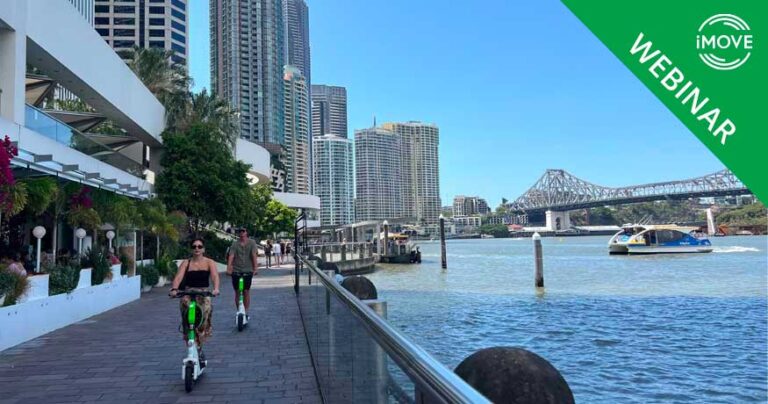
This 20 August 2026 webinar will unpack the completed iMOVE project, “Closing the loop on first/last mile transportation in Brisbane”.
An overview of the completed “SImpacts of eRideables on the transport task in WA” project, including a downloadable final report.
In addition to iMOVE and its partners’ micromobility projects listed above, as part of our Industry PhD Program businesses, universities and PhD students work on an agreed topic over a three-year period.
These are the three most recent PhD projects that have been undertaken on the topic of micromobility. Click to view all iMOVE’s micromobility PhD projects.
This PhD project will, at its conclusion, demonstrate how the roles and responsibilities of different stakeholders impact building a collaborative MaaS environment.
This PhD project explores cycle lane implementation from both a policymaker’s and user’s perspective, and flexible transport solutions for rural users.
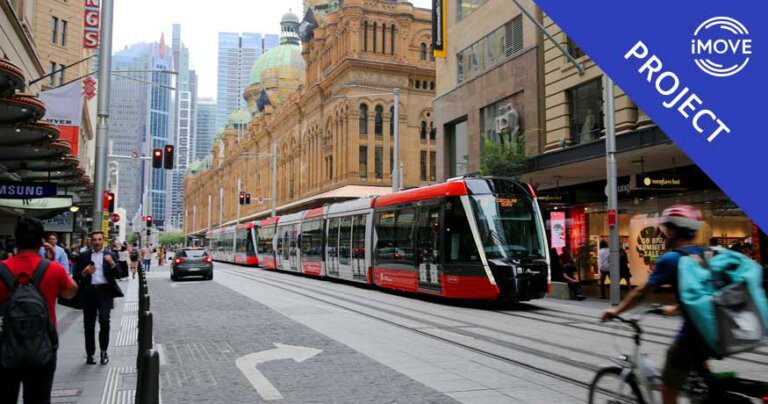
This research will focus on enhanced depiction of pedestrian and active mode interactions with vehicular traffic across a variety of road infrastructure scenarios.
In addition to projects, iMOVE also publishes articles, thoughtpieces, case studies, etc. that cover the many issues and solutions around micromobility.
Below are the three most recent articles. Or click to view all iMOVE’s micromobility articles.
An iMOVE project outcomes webinar, presenting findings from the iMOVE project “Promoting sustainable university travel choices”.
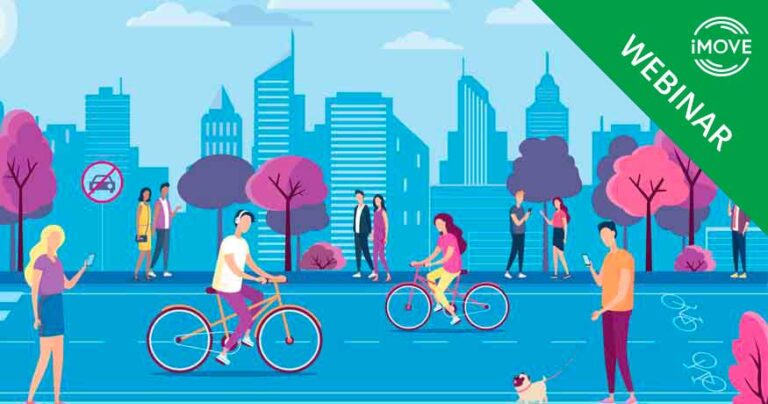
This webinar shares project outcomes that will help governments and service providers understand people’s motivations and concerns about active transport.
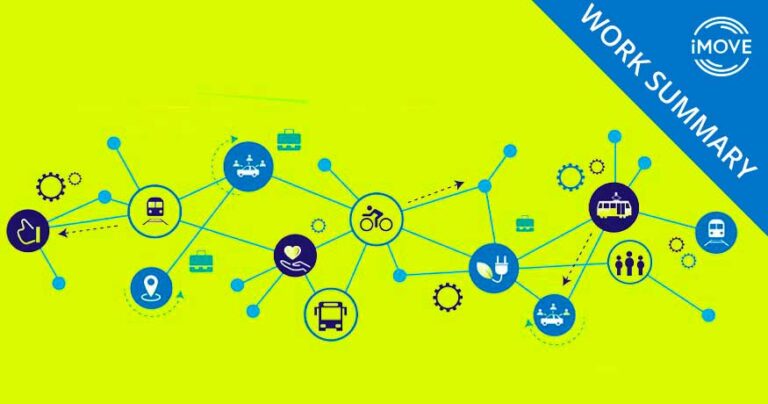
The Mobility as a Service: Research summary, conclusions and action recommendations report takes an overview of all MaaS work by iMOVE and its partners.