Connections: Micromobility and 50c public transport fares
This 20 August 2026 webinar will unpack the completed iMOVE project, “Closing the loop on first/last mile transportation in Brisbane”.


Stretching your legs rather than jumping in the car, active transport helps reduce your carbon footprint and travel expenses while increasing your mental and physical wellbeing.
In Australia’s car-centric culture, we can be quick to reach for the car keys even when making very short journeys. As an example, in the Australian Infrastructure Audit 2019 it was found that more than two million of the car trips taken in Sydney are less than two kilometres. In Melbourne the 2022 Victorian Integrated Survey of Travel and Activity (VISTA) assessed that 21% of trips of less than 1 kilometre are driven.
Getting children to school tells a similar tale of car reliance. According to the Climate Council’s Shifting Gear: The Path to Cleaner Transport (2023), “The national rate of active travel to or from school has dropped from 75% of trips to 25% over the past 40 years (Department of Transport 2021), with driving increasing due to time constraints, distances travelled and concerns over children’s safety.”
Considering these figures, it’s perhaps not surprising that 50% of Australians report low levels of physical activity. Almost a third of these people are classified as sedentary, according to the ABS’ Australian idle: Physical activity and sedentary behaviour of adult Australians. It’s a key influence on the fact that 63% of Australian adults aged 18 years and over are either overweight or obese.
Also known as active travel, active transport relates to physical activity undertaken as a means of transport. This includes walking, cycling and the use of other non-motorised vehicles such as skateboards, kick scooters, roller skates and roller blades.
Active transport involves undertaking a journey for a specific purpose, that might otherwise have involved motorised transport, rather than primarily for exercise or recreation. For example, walking to the shops to buy milk, rather than walking around the block purely for exercise. Active transport can also include walking or riding one more legs of a multi-modal journey.
Rates of active travel in Australia are low in comparison to many European and Asian countries, particularly for cycling.
Walking or riding rather than driving offers the two-fold benefit of increasing mental and physical health while reducing motorised transport’s impact on the environment.
Increased levels of active travel can alleviate the social and economic costs of significant public health issues like physical inactivity and depression.
Physically active people are less likely to become overweight. They’re also less likely to develop cardiovascular disease, type 2 diabetes, colon cancer, breast cancer, osteoporosis and depression. Physically active adults in the workforce have lower rates of absenteeism and increased job satisfaction.
Active transport can also build social capital, which is also associated with a wide range of positive health outcomes, by increasing social and community interaction.
At the same time, active transport also reduces carbon emissions from passive transport options like personal vehicles. Removing vehicles from the roads reduces traffic congestion, which has a range of flow-on environmental and economic benefits.
When considering the value of people’s time, road congestion cost the Australian economy $19 billion in 2016, according to Infrastructure Australia’s Urban Transport: Crowding and Congestion report. When considering emissions, a large sedan consumes around 1.5 litres of petrol per hour idling in traffic, while pumping another 1.8 kilograms of CO2 into the atmosphere. Even when cars are not at a standstill, the slower speeds and stop-and-go conditions of traffic congestion reduces fuel efficiency.
In 2015 the city of Wanneroo, in Western Australia, began the Your Move active transport program. Its aims were to increase physical activity and public transport use, and reduce reliance on cars to get from A to B. Almost 30,000 people signed up for the program in Wanneroo, with 75% of those sign-ups saying ther participation had changed their lives for the better.
At the time of writing (August 2023), the Your Move program is still in place, with the Western Australian government looking to sign up communities, schools, and workplaces.
One of the main challenges to increasing levels of active transport in Australia is the availability of safe and accessible walking and cycling options.
Pedestrians and cyclists are considered vulnerable road users, as they have little or no protection in the event of an accident on roads, footpaths and driveways. The safety of pedestrians and cyclists is also affected by the cold, wet winters in Australia’s southern states – which can involve commuting in the dark.
The majority of pedestrian Australian fatalities involve a collision with a light vehicle, with children and the elderly particularly vulnerable to injury or death in a crash. The majority of pedestrian deaths occurred in 50‑60 km/h zones in 2020, while a quarter of deaths were at intersections.
Similarly, half of Australian cyclist deaths occurred in 50-60 km/h zones and 56% occurred at intersections. Around a quarter were on higher speed roads, of 90 km/h and above, while a quarter involved a heavy vehicle.
Dedicated cycling lanes to address safety concerns continue to be controversial in major cities like Melbourne and Sydney, with a post-pandemic backlash against increased cycling lanes in the central business districts.
Likewise, there is also opposition to Melbourne City Council’s Future Streets Framework proposal to close some CBD streets to cars at peak times to reduce the number of people driving through the city and prioritise pedestrians.
Encouraging an increase in cycling for commuting also requires extending safe cycling networks further into the suburbs, as well as providing more secured and sheltered bicycle parking in the city centres and at major transport hubs.
Lack of time is also consistently reported as a major constraint on participation in physical activity such as active travel, according to VicHealth’s Active transport: Adults An overview of recent evidence report.
This is exacerbated by the fact that active transport, especially walking, is considerably slower than motorised transport. Limitations on how much people can carry when walking or riding can also make active transport impractical for short but heavy-laden trips such as weekly household grocery shopping.
When it comes to multi-model travel, gaps in transport infrastructure can make it impractical for some people to walk or ride to their nearest public transport option. Particularly in outer metropolitan suburbs, where transport infrastructure has failed to match the pace of urban sprawl.

The study will investigate how to integrate cycling facilities into urban and suburban environments in ways that address the concerns of the 48% of people who are “interested” in cycling, but “concerned” about safety. This group is known as the elusive “interested but concerned” cohort.
The project will provide Transport for NSW, and other government agencies, with an improved evidence base to develop the next iteration of cycleway design guidelines.
More details about the project, at: Safer cycling and street design: A guide for policymakers
Across Australia, city planners are looking to reduce reliance on motorised transport by making cities more walkable and bikeable. They are also embracing the concept of ensuring that more people have more of the amenities they require within walking distance of their home.
Active transport initiatives are primarily a matter for state, territory and local governments but, at a Federal level, the nation’s government road and transport ministers signed the National Road Safety Strategy 2011–2020. It aimed to reduce road deaths and serious injuries by 30% by 2020, as well as adopt the Safe System approach of “safe roads, safe speeds, safe vehicles and safe people”.
State and territory governments have addressed the issue in Victoria, NSW, the ACT, Queensland, TasmaniaE, South Australia, the Northern Territory and Western Australia, as have many cities and regional centres. Most active transport initiatives revolve around encouraging an increase in physical activity, improving cycling routes and improving road safety for cyclists and pedestrians. Bike-sharing services also encourage the use of active transport.
Around the world, urban planners have worked to address transport congestion, travel times and equity of access to amenities by ensuring that people can work, study, shop, play and access the facilities they need within walking distance of their home.
While that distance can vary, in Australia the focus is primarily on 30-minute cities to ensure people are less reliant on motorised transport to access their everyday needs.

“I don’t feel safe crossing this road because there is too much traffic and no pedestrian crossings,” or “I don’t feel safe riding along this street because there is too much traffic and no bike lanes.”
These are some of the responses from residents in and around the Melbourne suburb of Darebin.
Your Street, Your Say is a Local Area Planning project proposed by Darebin City Council with a focus on placemaking around streets. The goal of this project is to recommend a series of interventions and sub-projects for translating streets into better public spaces by building on aspirations of the local community (gathered through an extensive survey).
More details about the project, at: Your Street, Your Say: Better streets for Darebin
If you’re interested in pursuing a career in this area of transport, our interview series Meet Smart Mobility Experts could help guide you.
In this series we interview a number of researchers, practitioners, department of transport executives and more. Amongst other things we cover their academic background, research activity, career progression, and more.
Source: Cycling and Walking Australia and New Zealand’s National Walking and Cycling Participation Survey 2023
Source: Destinations – Heart Foundation
Source: Queensland Department of Transport and Main Roads, Queensland Walking Strategy
From the 2023 Australian Cycling and E-scooter Economy Report, looking at statistics from 2022:

Source: 2023 Australian Cycling and E-scooter Economy Report
As evidenced by our list of active transport projects and PhD projects, the work of iMOVE and its partners in the area of active transport touches on road safety, sustainability, community health, street design, transport planning, and more.
Our Light Insight Trial project saw 800 cyclists fit a smart bike light to collect, analyse, and visualise data, for evaluation of the technology’s ability to allow cyclists to overlay their experience on top of road safety insights. Further work on this technology is expected to take place, benefitting not only cyclists, the focus for this study, but also could in the future inform planning, investment and policy related to the ever-growing number of e-scooters and other micromobility vehicles entering the transport ecosystem.
“The Light Insight Trial has shown us the potential for technology to engage and invigorate a key community group on the topic of road safety and how road safety professionals and agencies can work with them to deliver the best outcomes. We’ve been overwhelmed by the support and passion shown from trial participants and key stakeholders and will continue to develop our engagement in this area through continued work with this cohort of riders,” said David Young, TAC’s Acting Manager Road Safety Research, Insights and Evaluation.
Additionally, we’re readying Australia’s next generations of experts and practitioners to help encourage active transport use via our Undergraduate Student Industry and Industry PhD programs.
If you’d like to talk to us about any R&D work in this area of transport please get in touch with us to start a discussion.
iMOVE, along with its partners, is active in carrying out R&D to plan Australia’s transport future.
Please find below the three latest active transport projects. Or click to view all iMOVE’s active transport projects.
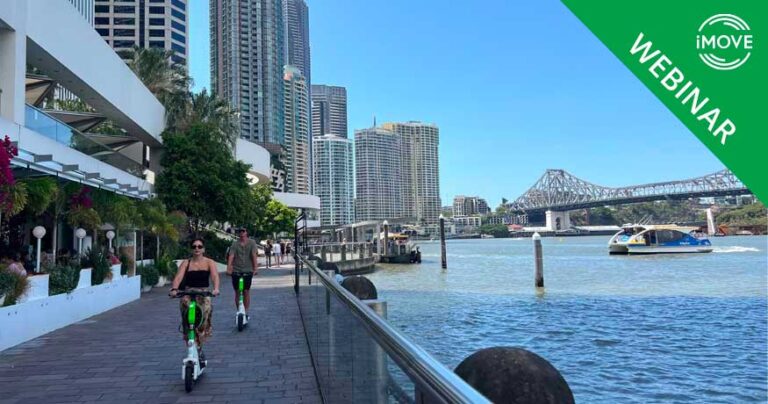
This 20 August 2026 webinar will unpack the completed iMOVE project, “Closing the loop on first/last mile transportation in Brisbane”.
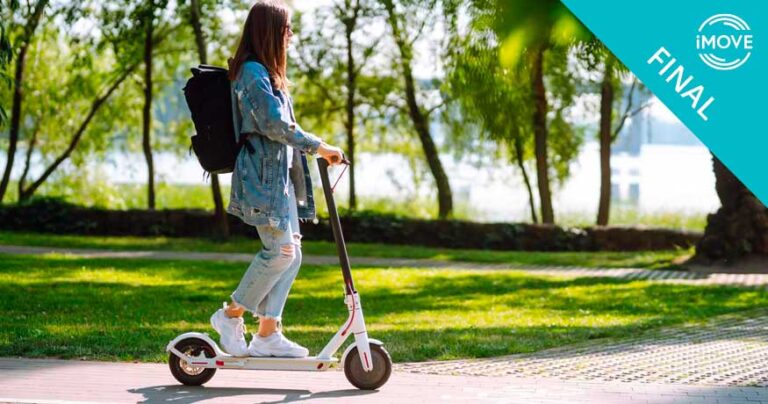
An overview of the completed “SImpacts of eRideables on the transport task in WA” project, including a downloadable final report.
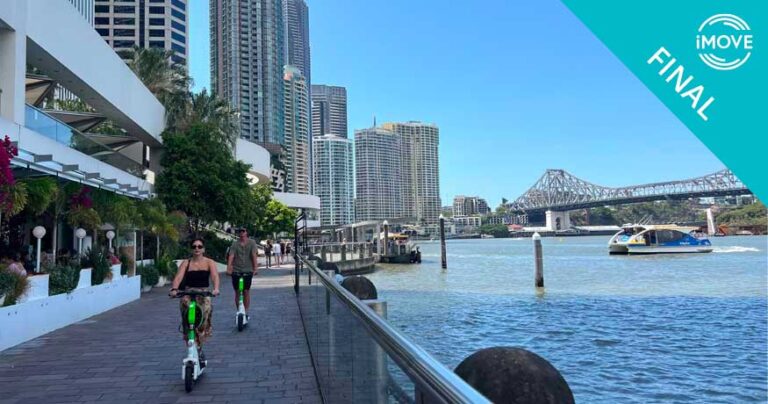
This work was conducted to assess opportunities and barriers on the important urban mobility challenge of first and last mile connectivity gaps for public transport users.
In addition to iMOVE and its partners’ active transport projects listed above, as part of our Industry PhD Program businesses, universities and PhD students work on an agreed topic over a three-year period.
These are the three most recent PhD projects that have been undertaken on the topic of active transport. Click to view all iMOVE’s active transport PhD projects.

Find out more about University of Western Australia PhD student Anna Gannet, and her work in the area of active school transport.

This PhD project explores cycle lane implementation from both a policymaker’s and user’s perspective, and flexible transport solutions for rural users.
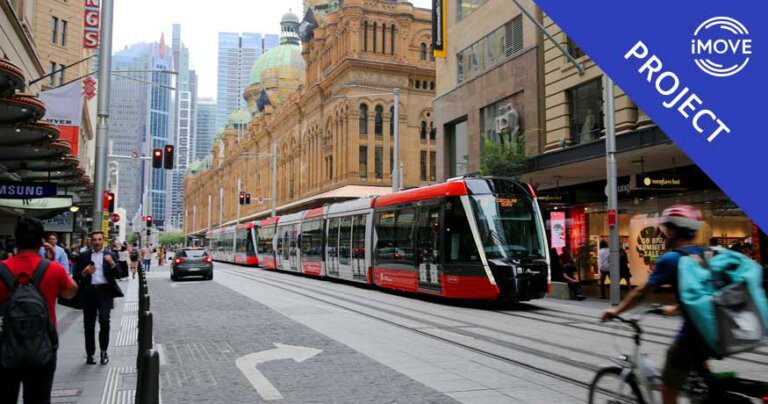
This research will focus on enhanced depiction of pedestrian and active mode interactions with vehicular traffic across a variety of road infrastructure scenarios.
In addition to projects, iMOVE also publishes articles, thoughtpieces, case studies, etc. that cover the many issues and solutions around active transport.
Below are the three most recent articles. Or click to view all iMOVE’s active transport articles.
An iMOVE project outcomes webinar, presenting findings from the iMOVE project “Promoting sustainable university travel choices”.
An overview of our completed project “Evaluation of the Wagga Wagga Active Travel Plan”, along with downloadable copies of the final reports.

This webinar shares project outcomes that will help governments and service providers understand people’s motivations and concerns about active transport.