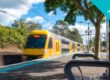
Active transport and travel demand in Brisbane

The Active transport data collection and travel demand study project with the Department of Transport and Main Roads and QUT has been completed. The final report for the project is available for download below.
Increasing active transport participation has the potential to help reduce traffic congestion, greenhouse gas emissions and air pollution, increase liveability, and promote health and well-being amongst others benefits.
Despite substantial infrastructure spending, however, the uptake of active transport modes remains modest in Australian cities. This under-utilisation is particularly pronounced in Brisbane, where vehicle kilometres travelled have increased by approximately 60% over the last two decades.
Objectives
The objective of this research was to gather empirical evidence that would improve understanding of the behavioural and contextual determinants of active transport choices.
Previous studies have mainly relied on travel surveys or Census data, both of which offered limited behavioural insights and fail to capture trip making decision processes. This study sought to include both attitudinal and behavioural data for evaluation.
Four key objectives underpinned this work:
- Characterise the demographic and attitudinal profiles of active transport users, for example confidence in using different modes.
- Identify behavioural patterns across study subgroups by analysing trip purposes and mode shares from web diary entries.
- Examine route selection behaviour based on travel diary data and assess the geographic distribution of trips and use of active transport infrastructure.
- Apply discrete choice modelling to estimate the effects of demographic, household and perceptual variables on mode choice relative to walking.
Methodology
The study included a questionnaire and a web-based smart travel diary, with data collected from over 600 participants in the Greater Brisbane area between July and October 2025.
Participants were recruited from three parallel channels:
- Social media posts on local active transport groups with URL links to the survey
- In-person flyer distribution with QR code survey links; and
- Via an online research panel managed by third parties targeting the Greater Brisbane area.
Participants were required to meet eligibility criteria which included:
- Being 15 years or older
- Residing in the Greater Brisbane area; and
- Engaging in some level of active transport (at least one destination-oriented active transport trip undertaken within the past seven days. For this survey, that was defined as walking, cycling, skateboarding or scootering to reach a destination, not solely to access public transport).
The questionnaire collected an array of detail including sociodemographic information, household composition and resources, driver’s licence status, access to vehicles and micromobility devices, self-reported confidence using active modes, weekly activity level and employment.
A smart travel diary was paired with the questionnaire to record trip level behaviour and the decision context for each trip. For every trip, participants recorded the start time, start and end locations, trip purpose, whether they travelled alone or with others, whether they paid for parking and whether they used any special devices (e.g. electric scooter).
The smart diary presented data as interactive maps through which participants could use waypoints to alter and adjust their route for that trip. They could also select any other modes they would normally consider for a similar trip as a means of capturing decision sets. Trip metadata was saved for each journey entered into the diary and a daily summary was rendered which participants could review and edit before submitting the day’s data.
Results
Survey results coupled with smart diary data indicated that mode choice was strongly influenced by access to transport resources and individual capabilities, rather than just attitudes alone.
Driving and walking accounted for the largest shares of recorded trips, with walking the most frequently recorded mode of active transport. Amongst other findings:
- Over 90% of participants indicated they had ownership of a vehicle, followed by bicycles at over 37%. Only 12% of participants revealed they owned e-bikes, e-scooters or motorbikes.
- Micromobility use was limited overall with 65% of participants indicating they did not use e-bikes or e-scooters. Lack of riding skills and/or lack of confidence was commonly cited as reasons for non-use.
- The most frequently cited barrier to active transport was car / traffic safety concerns and lack of physically separated lanes, with inadequate lighting, distance, geography and weather amongst other factors reported.
- Several motivators were reported to encourage active transport use, including distance to destination, more separated cycling/walking paths and reduced travel time.
- Active modes were found to be mainly used for proximity and lifestyle trips, while motorised travel was more common for commuting and household responsibilities.
- While walking participation was fairly consistent amongst age categories (slightly higher amongst women), some age and gender trends emerged amongst the findings, including:
- Female participation in cycling was quite low in some age groups, with participation in this mode highest amongst young males aged 15 to 24.
- Driving increased with age, peaking with 45- to 64-year-olds, while transit use was most prevalent for young adults aged 25 to 34.
- Overall, males were more likely to use active modes, while women had slightly higher participation rates in walking and driving at mid-life stages.
Consclusions
Travel mode choice is influenced by a multitude of considerations including transport resource access, individual capabilities and household responsibilities.
Travellers’ choice sets are constrained by distance, material access and confidence, and people’s resources, skills and familiarity influence their propensity to adopt different travel modes.
The findings from this work indicate that effective active transport policy needs a coordinated, multi-pronged approach, and interventions should not assume uniform participation as age and life-stage differences also impact travel choices.
Recommendations
The final report’s recommendations include:
- Prioritising environments that support short trips and concentrate active transport investment around employment-rich destinations.
- Pairing infrastructure investment with initiatives that help build individual capacity, with access to active transport equipment supported.
- Adopting place-based transport strategies and integrating land use and transport planning to help reduce structural travel constraints.
Download the final report
Download your copy of the final report, Active Transport and Travel Demand in Brisbane: Insights from Survey and Smart Travel Diary Data, by clicking the button below.
DOWNLOAD THE REPORTDiscover more from iMOVE Australia Cooperative Research Centre | Transport R&D
Subscribe to get the latest posts sent to your email.